
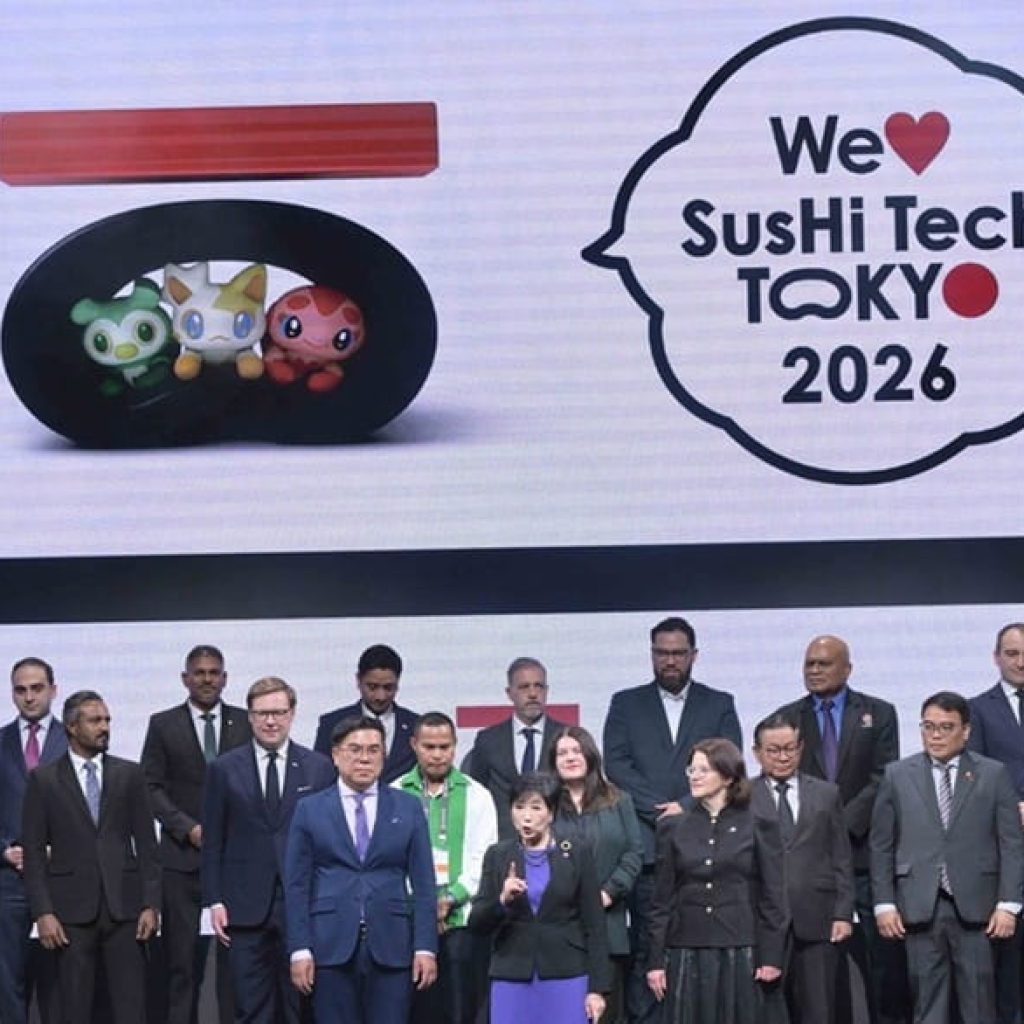
TOKYO, April 27, 2026 – As SusHi Tech Tokyo 2026 officially opened this morning at Tokyo Big Sight, Tokyo Governor Yuriko Koike used her keynote address to reinforce a clear message: the future of cities will depend on how effectively technology can be harnessed to address climate risk, energy transition and urban resilience.
For CarbonWire, the significance of this year’s edition lies in how sustainability is no longer positioned as a parallel conversation, but as the foundation of the event itself.
SusHi Tech — short for Sustainable High City Tech Tokyo — was created around the central idea of building sustainable cities through innovation. Now in its fourth edition, the platform has evolved into one of Asia’s most important climate-tech and urban innovation gatherings, bringing together startups, investors, policymakers and city leaders from more than 60 countries.
Held from April 27 to 29, the event is expected to host over 700 startup exhibitors, more than 10,000 business meetings, and approximately 60,000 participants, reflecting the scale of global interest around sustainable urban transformation.
Sustainability as the Core Theme
Governor Koike’s address emphasised that cities are now at the frontline of the climate challenge. From extreme weather and disaster preparedness to decarbonisation, energy efficiency and ageing infrastructure, urban centres must rethink how they are designed and managed.
Through SusHi Tech Tokyo, the Tokyo Metropolitan Government aims to create a platform where these challenges are addressed not only through policy, but through deployable innovation.
Koike has previously described the vision as creating “a truly distinctive conference that attracts ecosystems from around the world,” one where startups and global stakeholders can collaborate to solve real urban problems.
This aligns closely with Tokyo’s broader sustainability ambitions, including its Tokyo 2050 Strategy, which focuses on decarbonisation, resilience and long-term environmental planning.
Climate Resilience and Disaster Preparedness
One of the strongest sustainability pillars at SusHi Tech Tokyo 2026 is resilience, with dedicated sessions and startup showcases focused on climate adaptation and disaster response.
This includes:
- flood and heat resilience technologies
- satellite-based environmental monitoring
- resilient infrastructure systems
- disaster simulation and response tools
- cybersecurity for critical urban systems
The event also hosts the G-NETS Leaders Summit, where leaders from 55 cities across five continents are gathering under the theme of “A New Urban Future built on Climate and Disaster Resilience.”
This positions SusHi Tech as more than a startup conference, it is increasingly a platform for climate diplomacy and city-level action.
Climate Tech Investment and Circular Economy
Alongside resilience, climate tech investment remains a major focus. The conference includes discussions around:
- carbon capture and emissions reduction
- circular economy business models
- clean energy systems
- sustainable mobility
- materials innovation and resource efficiency
One featured session asks: “Can We Build Cities that Capture CO₂ from the Air?”, reflecting how urban climate solutions are moving from concept to implementation.
For startups, the opportunity lies in moving beyond ESG narratives toward measurable climate outcomes and scalable business models.
What distinguishes SusHi Tech Tokyo is its emphasis on implementation. Structured business matching, investor zones, corporate reverse pitches and dedicated sustainability showcases are designed to help climate-focused startups move faster from pilot stage to deployment.
This reflects a broader shift across Asia-Pacific, where the climate conversation is increasingly centred on execution rather than ambition alone.
Tokyo is positioning itself as a testbed for that next phase.
A Global Platform for Sustainable Cities
Governor Koike’s opening message made clear that sustainability is not a single sector, it is the organising principle of future cities.
Whether through energy systems, AI-enabled infrastructure, resilient supply chains or circular economy solutions, the goal is to create urban environments that are both economically competitive and environmentally viable.
As SusHi Tech Tokyo 2026 begins, Tokyo is sending a strong signal to the global climate-tech ecosystem: the future of sustainability will be built in cities, and cities must be built through collaboration.